
Search Fillmore County Genealogy Records
Fillmore County genealogy records go back to 1853 when the county was formed, covering birth, death, marriage, land, probate, census, and church records held at the courthouse in Preston, at the Fillmore County Historical Society in Fountain, and through state archives and MNGenWeb. The county's deep genealogical library makes it one of the better-documented counties in southern Minnesota.
Fillmore County Overview
Fillmore County Historical Society
The Fillmore County Historical Society in Fountain is one of the most complete local history resources in Minnesota. The Emery and Almeda Eickhoff Genealogy Library within the society is considered one of the best organized local genealogy libraries in the state. Their collections span birth, death, and marriage documents, census records, cemetery transcriptions, obituaries, church records, and county histories.
Visiting hours are Tuesday through Saturday, 10am to 3pm, and the society is closed on major holidays. Mail order copies of records are available, and digital indexes are on the society's website. For remote research requests, email info@fillmorecountyhistory.org. The society maintains thousands of photographs and an extensive microfilmed newspaper collection that can help fill gaps in other records.
Membership is open to anyone with ties to Fillmore County or an interest in its history. Individual memberships start at $20 per year, with student and family tiers also available.
| Organization | Fillmore County Historical Society |
|---|---|
| Address | 202 County Rd 8, Fountain, MN 55935 |
| Phone | 507-268-4449 |
| info@fillmorecountyhistory.org | |
| Hours | Tuesday-Saturday, 10am-3pm (closed major holidays) |
| Website | fillmorecountyhistory.org |
Fillmore County Recorder
The Fillmore County Recorder in Preston holds official vital records for the county. Birth and death certificates, marriage licenses, and land records are all maintained there. For certified copies, contact the recorder directly or use the Minnesota Department of Health for state-level birth and death records.
Fillmore County birth records go back to 1853, which is earlier than statewide registration. That means the county has a longer record trail than many Minnesota counties for births and deaths. Marriage records also date to the county's early years and are a good source for tracing family connections.
| Office | Fillmore County Recorder |
|---|---|
| Location | Preston, MN (County Seat) |
| Birth Records | From 1853 |
| Death Records | From 1853 |
| Marriage Records | From 1853 |
| State Vital Records | Minnesota Department of Health |
Fillmore County MNGenWeb
The Fillmore County MNGenWeb site provides free online genealogy data for the county as part of the statewide MNGenWeb project. You can find transcribed records, cemetery listings, and links to digitized sources from Fillmore County. It is a good starting point if you want to search before making a trip or mailing a request.
The MNGenWeb project for Fillmore County connects to broader resources including FamilySearch historical images, which include land records from 1852 to 1908 and probate records from 1858 to 1965. These are free to access online and cover a substantial range of the county's early record history.
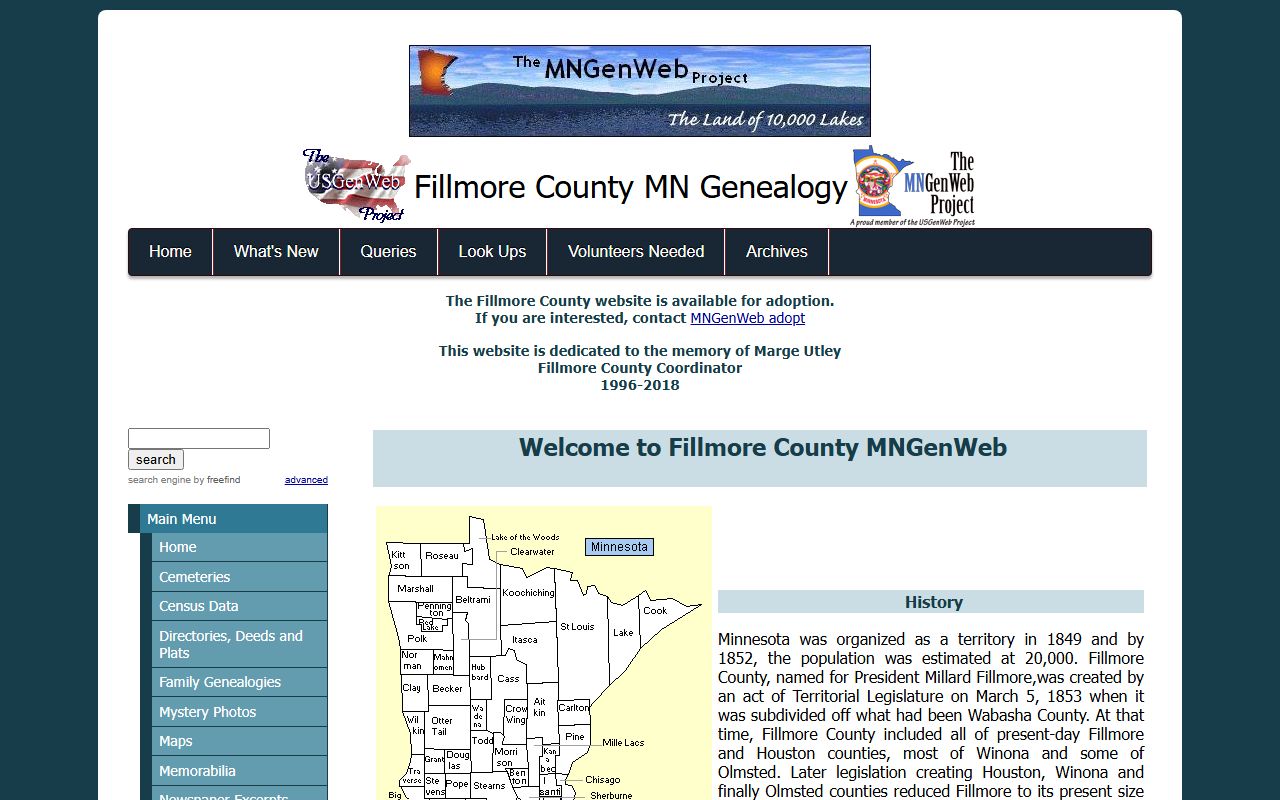
The Fillmore County MNGenWeb site links to free transcribed records, digitized county documents, and contributed family histories for researchers tracing ancestors in this corner of Minnesota.
Available Records in Fillmore County
Fillmore County has an unusually broad set of genealogical records going back to the county's formation in 1853. Between the historical society, the county recorder, and online archives, researchers have access to a wide range of primary sources.
- Birth, death, marriage records from 1853 (County Recorder, Historical Society)
- Land records 1852-1908 (FamilySearch)
- Probate records and wills 1858-1965 (FamilySearch, Courthouse)
- Census records 1850-1940 (Historical Society, FamilySearch)
- Cemetery records (Historical Society)
- Church records (Historical Society)
- Thousands of historical photographs (Historical Society)
- Microfilmed county newspapers (Historical Society)
The society also holds the 1905 volume "History of Fillmore County" by Goodrich, which contains biographical sketches and community histories useful for placing ancestors in context.
Searching Fillmore County Records Online
The MHS People Records Search at the Minnesota Historical Society is a free tool covering birth indexes from 1900 to 1934, death records from 1904 to 2001, and state census records from 1849 to 1905. For Fillmore County, where records go back to 1853, state registration data may complement but not replace the older county sources.
For marriage records, the Minnesota Official Marriage System (MOMS) lets you search by county, name, or date and request certified copies online. FamilySearch has extensive Fillmore County collections including land and probate documents from the county's earliest decades.
The Bureau of Land Management's GLO Records database has original land patents for Fillmore County from the mid-1800s. These can be cross-referenced with county deed books to trace how property moved through families over time.
Note: The Peterson Station Museum in Preston (507-875-2415) holds additional local history materials related to the area's early settlers that may supplement the main historical society collections.
Local Museums and Additional Resources
Fillmore County has several local museums that hold records and artifacts related to early county families. The 1877 Peterson Station Museum in Preston can be reached at 507-875-2415. Other resources include the Canton Depot, the Chatfield Historical Museum and Archives, Ed's Museum (Wykoff Area Historical Society) at 507-951-5734, the Mitson House Museum run by the Canton Historical Society, the Rushford Area Historical Society Museum at 507-864-7560, and the Spring Valley Methodist Church Museum.
Each of these sites may hold records specific to their community that don't appear in the main county collections. If your ancestor lived in one of these towns, a direct contact with the local museum can turn up unique sources.
Nearby Counties
Fillmore County's neighbors to the north, east, south, and west all have their own record collections. Early Fillmore County originally included parts of Houston, Winona, and Olmsted counties, so records for the same family may turn up in more than one county.