
Search Minnesota Genealogy Records
Minnesota genealogy records span more than 150 years of birth, death, marriage, land, and census data held at state agencies and 87 county offices. If you are tracing your family roots in Minnesota, you can search millions of records online for free through the Minnesota Historical Society and the state vital records system. This guide covers the main sources for genealogy research in Minnesota, how to request records, what fees to expect, and where to look when online tools don't turn up what you need.
Minnesota Genealogy Records Overview
Where to Find Minnesota Genealogy Records
Minnesota genealogy research starts in a few key places. The Minnesota Historical Society (MHS) is the main state repository for genealogy records. They hold birth and death indexes from 1900, state census records going back to 1849, naturalization papers from all 87 counties, probate records, and much more. You can search many of these at mnhs.org/search/people for free. The Gale Family Library in St. Paul holds physical collections and offers in-person research access for records not yet digitized.
The Minnesota Department of Health (MDH) Office of Vital Records keeps certified birth and death records from 1900 and 1908 respectively. They handle requests by mail or fax only. No in-person service is available through MDH. For faster turnaround, you can often get the same records in person at the county vital records office where the birth or death took place. Counties keep their own copies and can issue certified copies the same day you visit.
Marriage and divorce records stay at the county level since MDH does not keep those files. For marriage searches, the statewide Minnesota Official Marriage System (MOMS) lets you search an index of Minnesota marriage records from 1850 to the present at no cost. The Minnesota Department of Health vital records page has current processing times and all the forms you need to request birth, death, and related records.
The screenshot below shows the MDH vital records portal, which is the main gateway for requesting certified birth and death records from the state.
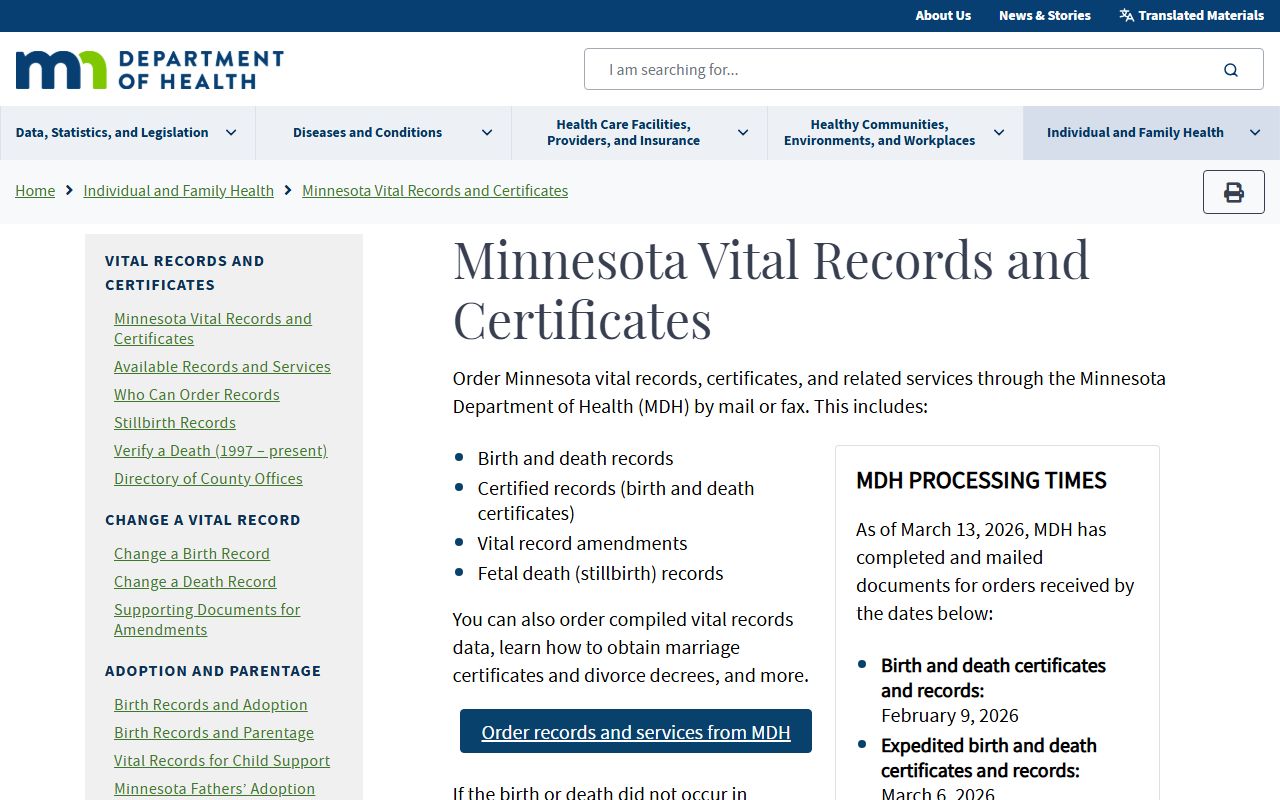
The MDH vital records office processes requests by mail and fax. It accepts credit card, check, or money order. Processing times vary and are posted on the MDH website.
Birth and Death Records in Minnesota
State-level birth records in Minnesota go back to 1900. Death records start in 1908 at the state level, though some counties have earlier records that were never forwarded to the state. The MHS People Records Search holds a free index of births from 1900 to 1934 and deaths from 1904 to 2001. For records outside those date ranges, contact the county where the event took place.
Certified birth certificates cost $26 per copy through the Minnesota Department of Health. Death certificates cost $13 each. If you only need a noncertified copy for research, you can get one for $13. Verification of basic birth or death facts costs $9. These fees apply whether you request from MDH or from a county vital records office. Fees are non-refundable even if the record is not found. Birth dates from 1900 to 2000 are available from MDH or from the county where the birth occurred. Birth dates before 1900 are only available from the county where the birth was recorded.
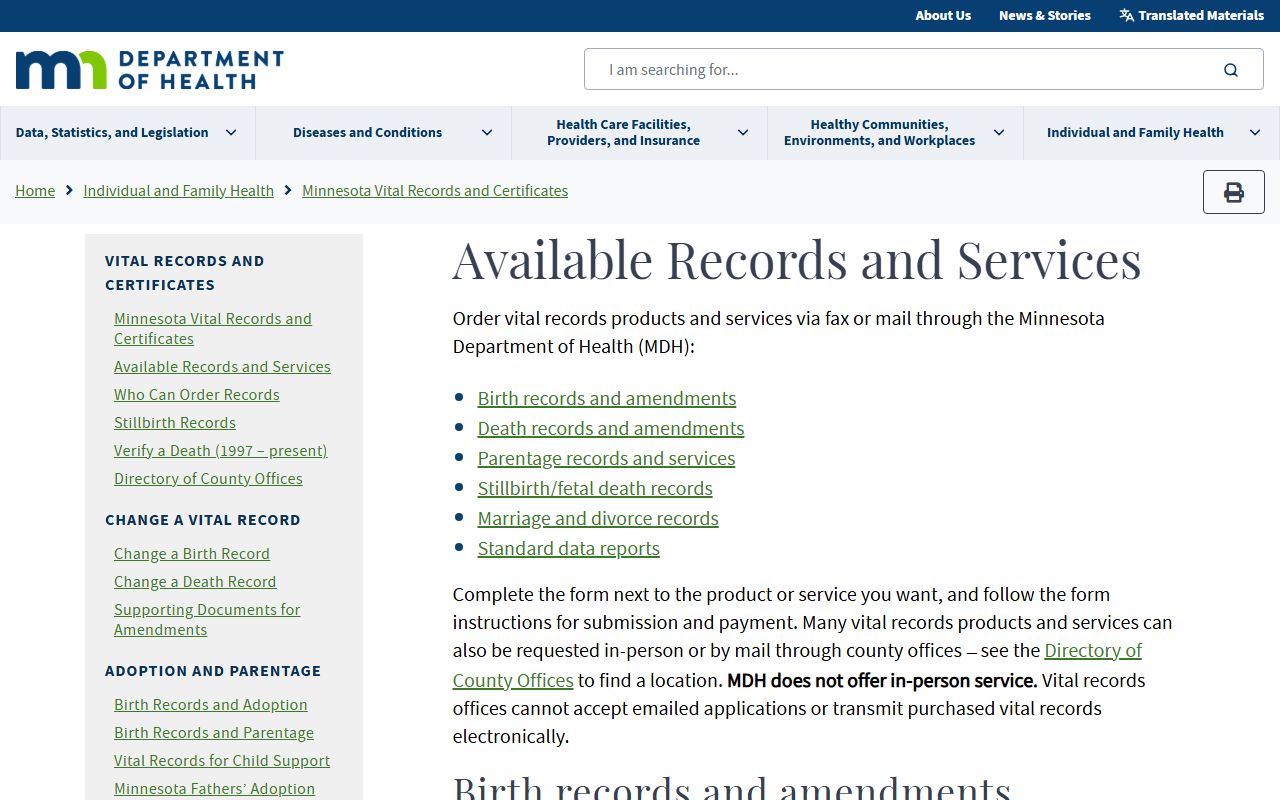
You can request birth or death records by mail, by fax, or in person at the county where the event was recorded. MDH does not have a walk-in office. If you need same-day service, go directly to the county vital records office. Most county offices can issue certified copies while you wait. You need valid government-issued photo ID to request records in most cases. If you don't have ID, you can use a Statement to Identify form with a witness.
Noncertified birth records are printed on plain paper. They work well for genealogy research but cannot be used for legal identification purposes.
Under Minnesota Statute 144.225, most birth and death records are public. An exception covers birth records of children born to unmarried parents, which are confidential for 100 years. Death records are fully public and anyone can buy a noncertified copy. Certified copies require proof of a tangible interest in the record, which includes close family members, legal representatives, and others with a documented legal need.
Marriage Records and the MOMS Database
Minnesota marriage records are held at the county level. MDH does not keep marriage records or issue marriage certificates. If you need a certified copy, contact the county recorder in the county where the marriage license was issued. The county that issued the license holds the original record, not the county where the ceremony took place.
For free online searching, use the Minnesota Official Marriage System, known as MOMS. This statewide index covers most Minnesota marriage records from 1850 to the present. It was built and is maintained by Minnesota counties. MOMS shows bride and groom names, marriage date, county of record, and the certificate number for some records. It does not provide images or certified copies. Use it to find which county holds the record, then contact that county for a certified copy.
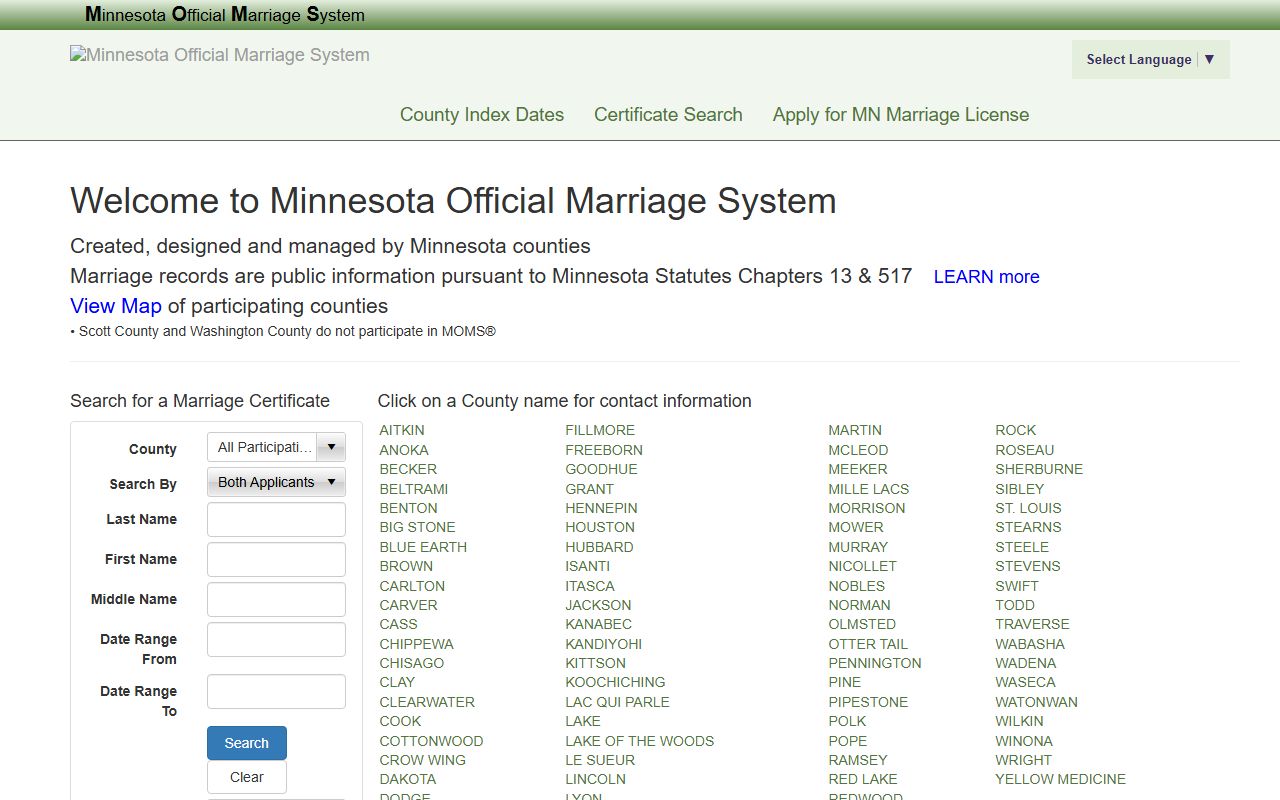
MOMS is a free public search tool. Some early county records have gaps in coverage, especially before statewide recording was standardized in the late 1800s.
Minnesota State Census Records
Minnesota conducted its own state censuses separate from the federal count. State census years are 1849, 1853, 1855, 1857, 1865, 1875, 1885, 1895, and 1905. These records fall in off-years from the federal census, which makes them useful for tracking families between federal census dates. State censuses asked fewer questions than federal ones but typically include name, age, gender, birthplace, and parents' birthplaces.
All Minnesota state census records are searchable for free through the MHS People Records Search at mnhs.org/search/people. You can view the original record images online for most years. The MNHS state census guide explains what each census year contains and how to use the collection.
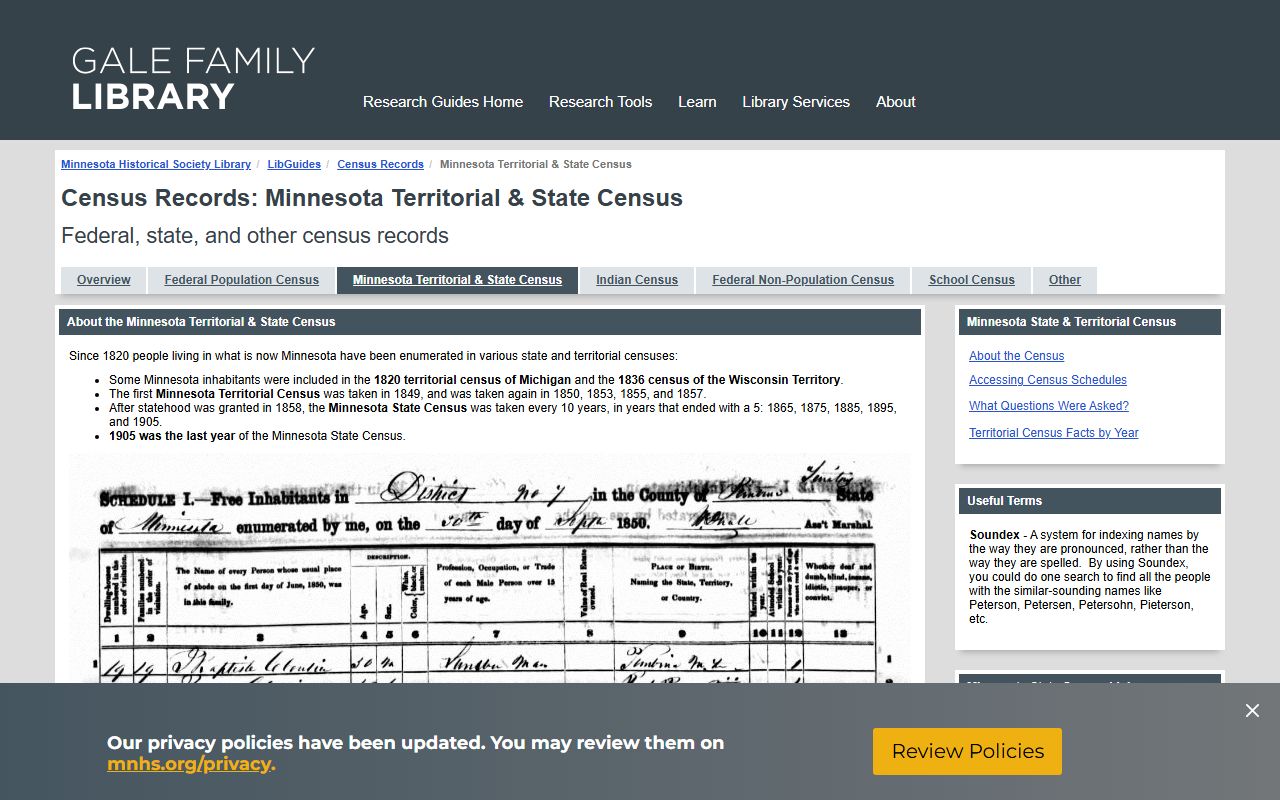
The MNHS census research guide includes tips on searching across multiple years and understanding what information each Minnesota census collected.
The 1895 state census is especially detailed and one of the most heavily used genealogy records in Minnesota. An index with digital images is available through the Gale Family Library at MHS. For the territorial censuses from 1849 to 1857, coverage is less complete but what exists is searchable online. The state census works well alongside the federal census, and the two together can show how a family moved or changed over time.
Minnesota Historical Society Gale Family Library
The Gale Family Library at the Minnesota Historical Society is the main in-person research destination for genealogy work in Minnesota. The address is 345 Kellogg Boulevard West, St. Paul, MN 55102. Phone: 651-259-3300. Email: reference@mnhs.org. Hours run Tuesday through Saturday, though check the website for current times before visiting. The library is closed on Mondays and Sundays.
The library holds naturalization records from all 87 Minnesota counties, probate records and will books from 1849 through the mid-1980s, county court records, Minnesota newspapers from 1849 to the present, city directories, and county atlases. In-library databases include Ancestry Library Edition, Heritage Quest Online, and digital Sanborn maps. The Gale Family Library is a FamilySearch Affiliate Library, which means you can access some FamilySearch records there that are not available to home researchers.
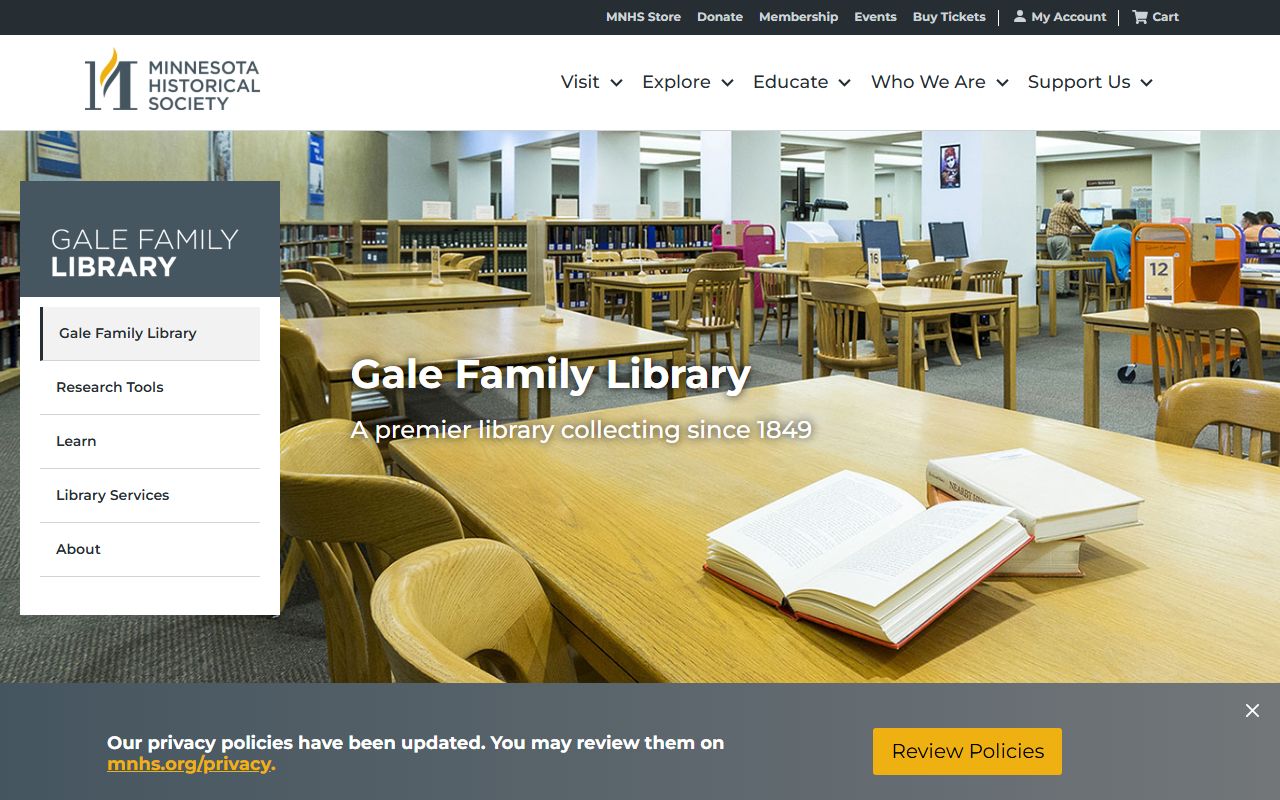
The Gale Family Library in St. Paul holds the core of Minnesota's archival genealogy collection, including records that are not yet available online.
MHS offers paid research services for records not available online. Services include will book requests, pre-1900 birth and death research, city directory searches, court records searches, marriage record requests, military records requests, newspaper obituary lookups, and railroad employee index searches. The MNHS vital records research guide at libguides.mnhs.org/vital covers how to find birth and death records at both the state and county level.
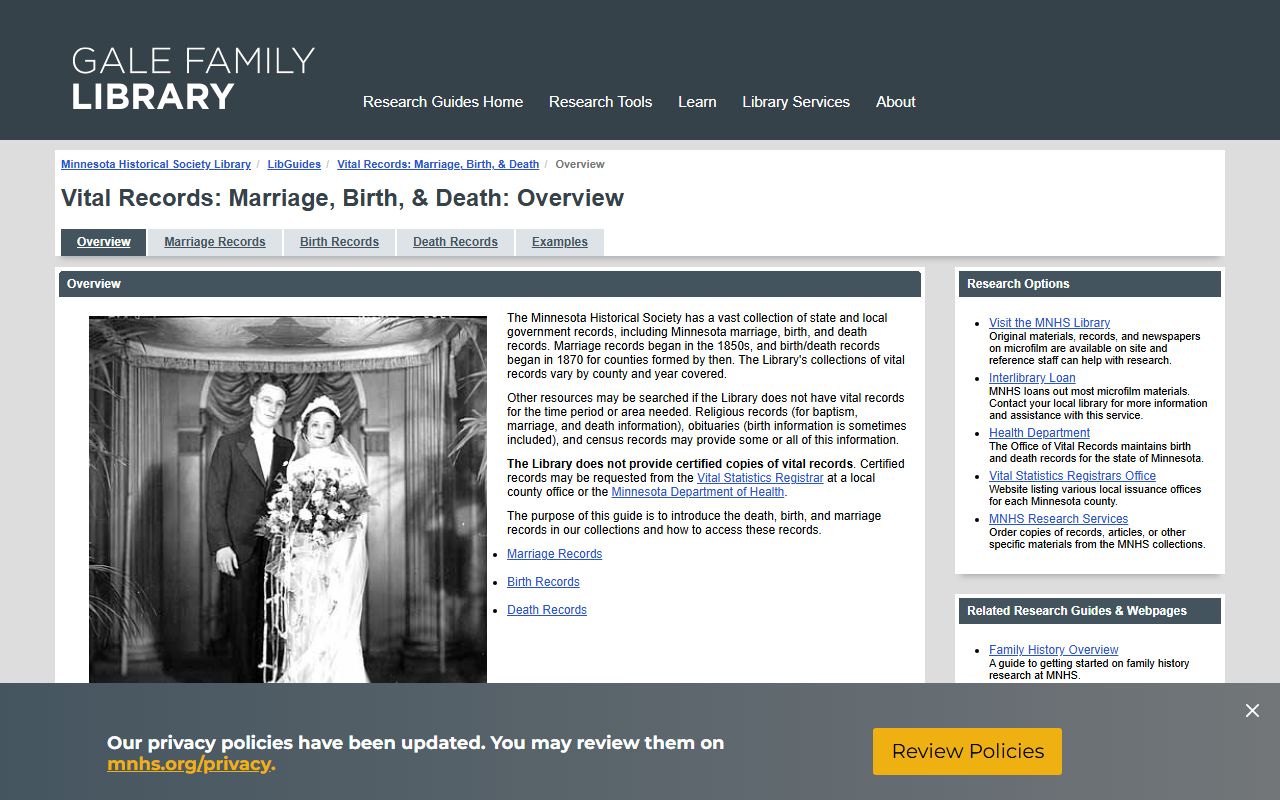
The MNHS vital records guide is a practical starting point for anyone researching birth, death, or marriage records in Minnesota.
Land Records and Property Documents
Minnesota is a public-domain (Federal-Land) state, meaning the federal government originally distributed land to settlers through homestead claims, cash purchases, and other patent grants. The Bureau of Land Management holds pre-1908 federal land patents and conveyance records. You can search and view these for free at glorecords.blm.gov. The database includes Minnesota land patents, tract books, and survey plats. Land patents connect a person to a specific location in a specific year, which is useful when other records are thin or missing.
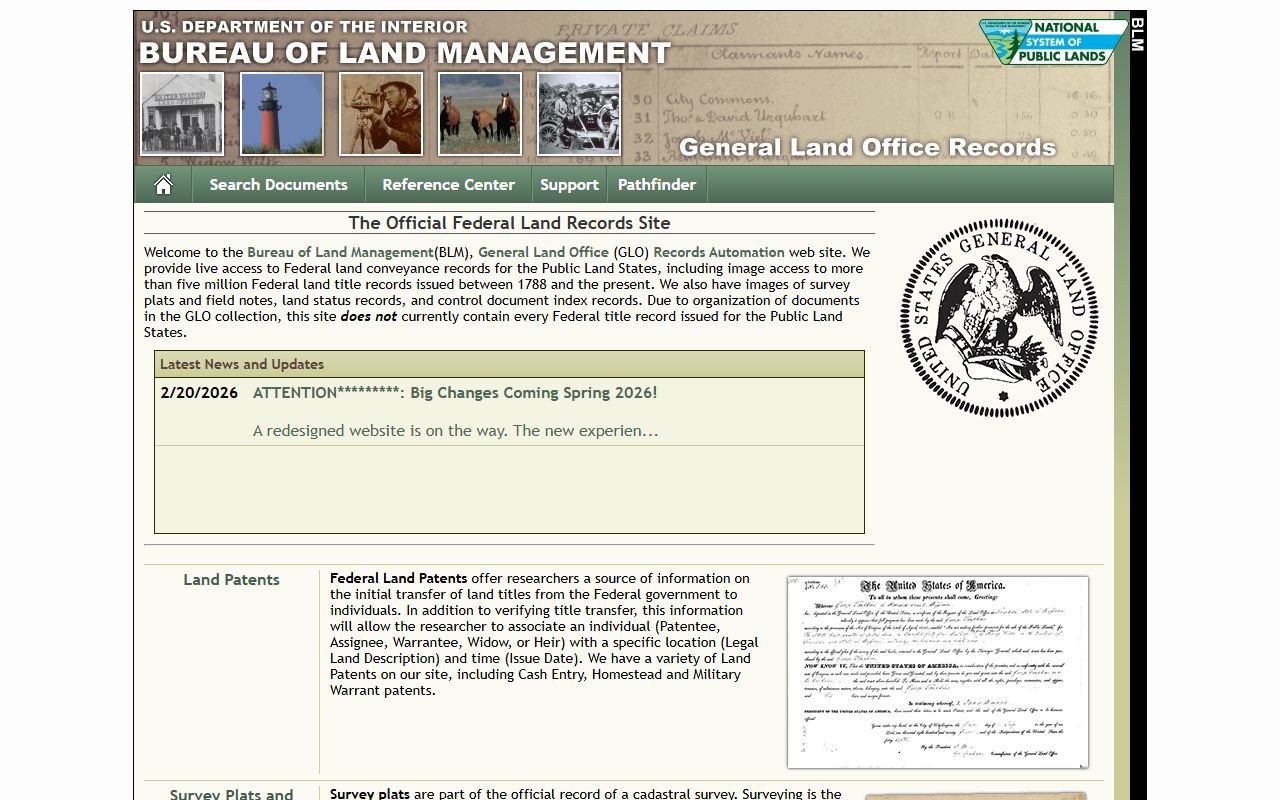
The BLM records database covers federal land patents issued before 1908. It is one of the best free resources for early Minnesota settler and homestead research.
The MHS State Archives holds state land office records including school land patents from 1863 to 1942, university land patents, agricultural college patents, and swamp land patents. County recorder offices keep current land records. Older county land records going back to the 1850s and 1860s are often available on FamilySearch or through the county recorder directly. Some counties have digitized their deed indexes, making it possible to search before visiting in person.
Veterans Graves Registration Records
The Minnesota Veterans Graves Registration program created about 70,000 records covering veterans buried in Minnesota from 1857 to 1975. The bulk of the records come from 1927 to 1969. Each report includes the veteran's full name, dates of enlistment and discharge, rank and unit, birth date, death date, cause of death, next of kin information, and grave location. Wars represented include the Civil War, Spanish-American War, World War I, World War II, Korean War, and Vietnam War.
These records are searchable through the MHS People Records Search at mnhs.org. The index is free to search and original report images are viewable online. Not every veteran buried in Minnesota appears in the records. Coverage is especially incomplete before 1927 and after 1969. Only veterans buried in Minnesota are listed, not those who enlisted from Minnesota but were buried elsewhere.
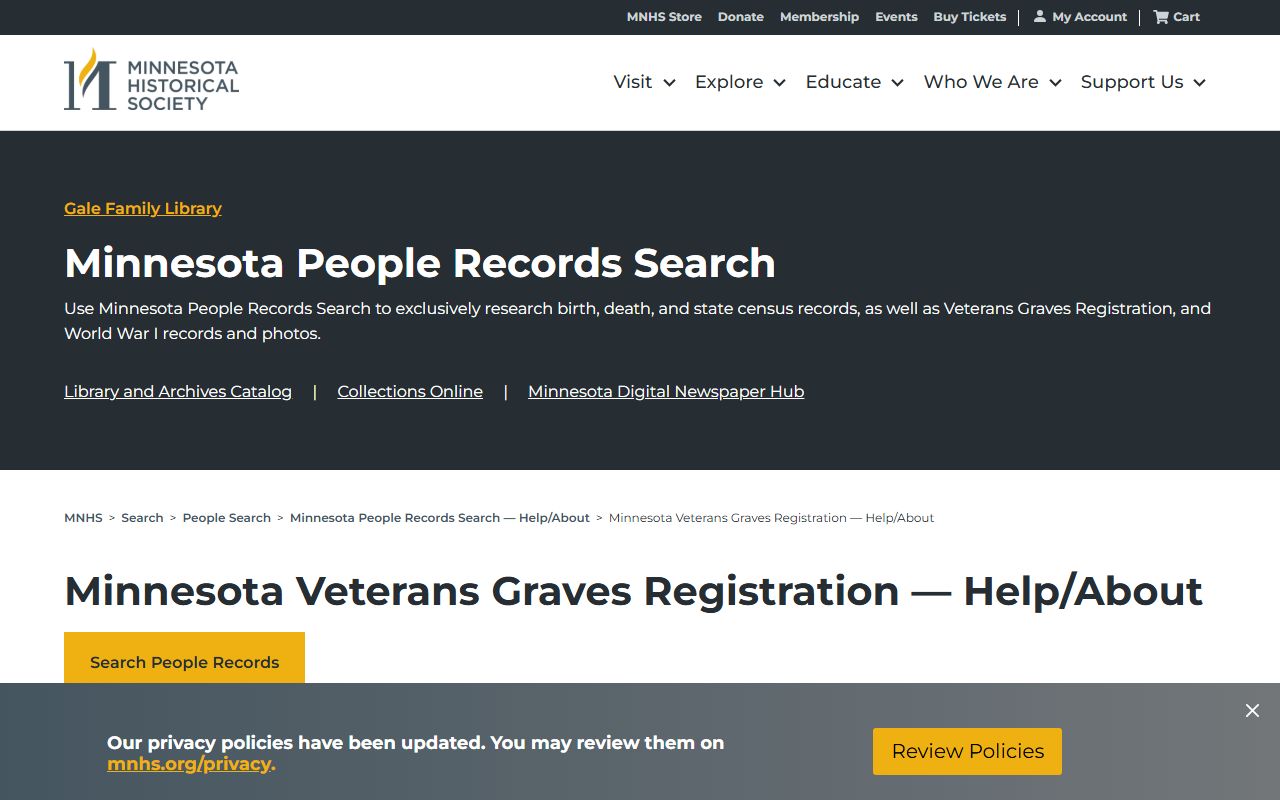
The veterans graves registration records also include Gold Star Roll data and World War I bonus and service questionnaires available through the MHS People Records Search.
Naturalization and Immigration Records
Naturalization records document the process immigrants went through to become U.S. citizens. Minnesota holds a large collection at the MHS State Archives covering all 87 counties. Record types include Declarations of Intent, Petitions for Naturalization, Certificates of Naturalization, and military naturalizations. Most of these records date from the 1850s through the 1950s. The collection is available for research at the Gale Family Library in St. Paul, and some records are also available on microfilm through interlibrary loan.
The Immigration History Research Center at the University of Minnesota in Minneapolis holds immigration manuscripts and ethnic community records. Their address is 311 Andersen Library, 222-21st Avenue South, Minneapolis. Phone: (612) 625-3346. Website: ihrc.umn.edu. This center is particularly strong for Scandinavian, Eastern European, and other immigrant communities that settled in Minnesota in large numbers during the late 1800s and early 1900s.
Probate Records and Wills in Minnesota
Probate records in Minnesota are held at two levels. Recent records are at the county district court in the county where the deceased lived. Older probate records, especially from the 1800s and early 1900s, have been transferred to the MHS State Archives. A Will Books Index covering 1849 to 1985 is searchable through FamilySearch.org at no cost. This index does not include Hennepin, Marshall, or St. Louis counties. For those counties, contact the respective district court or MHS directly.
To get a copy of a will or probate file, search the FamilySearch index to confirm the record exists and note the volume and image number. You can then order a copy through the MHS shop. For recent probate records not yet transferred to MHS, contact the court administrator at the county district court. Some probate case files from the 1900s are available on microfilm through interlibrary loan from MHS.
Adoption Records in Minnesota
Minnesota law changed on July 1, 2024, expanding access to original birth records for adopted persons. Under Minnesota Statute 144.2252, adopted persons who are 18 or older can now request a noncertified copy of their original birth record. If the adopted person is deceased, their spouse, child, grandchild, or legal representative can make the request. Requests go to the MDH Office of Vital Records only. The fee is $40.
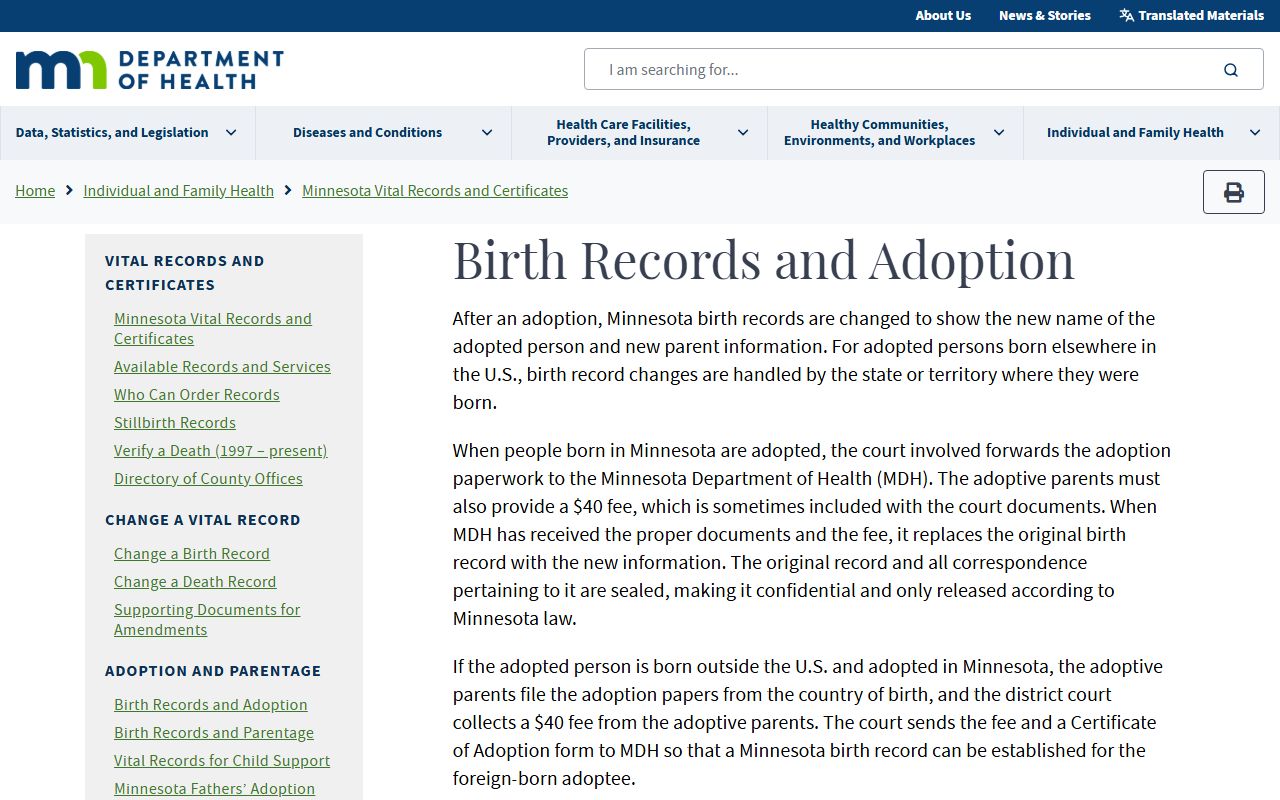
The MDH adoption records page explains what documents you receive when requesting an original birth record, including any contact preference forms submitted by birth parents.
What you receive with an adoption record request includes the noncertified copy of the original birth record, evidence of adoption such as the court file number and date, and a contact preference form if the birth parent submitted one. The copy clearly states it may not be used for identification. Earlier adoption records remain closed for 100 years from the date of adoption under related sections of the Minnesota Statutes.
Minnesota Genealogy Laws and Record Access
Minnesota vital records law runs through Minnesota Statutes Sections 144.211 through 144.227. These sections cover how vital records are registered, who can access them, what fees apply, and what penalties exist for false statements or unauthorized disclosure. The key access provision in Section 144.225 defines tangible interest as the standard for receiving certified copies. That group includes the record subject, close family members, legal representatives, and others with documented legal needs.
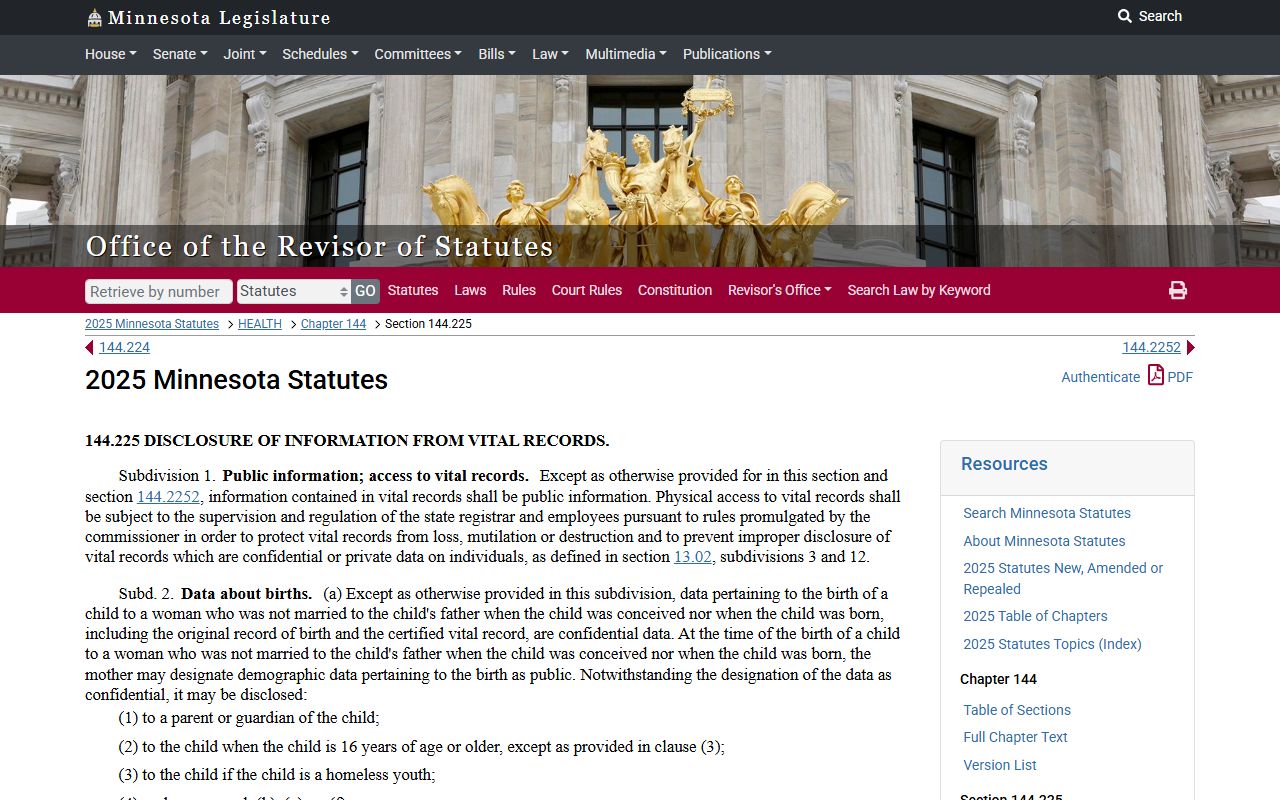
Minnesota Statute 144.225 is the core access law for vital records and determines who has the right to receive certified copies of birth and death certificates.
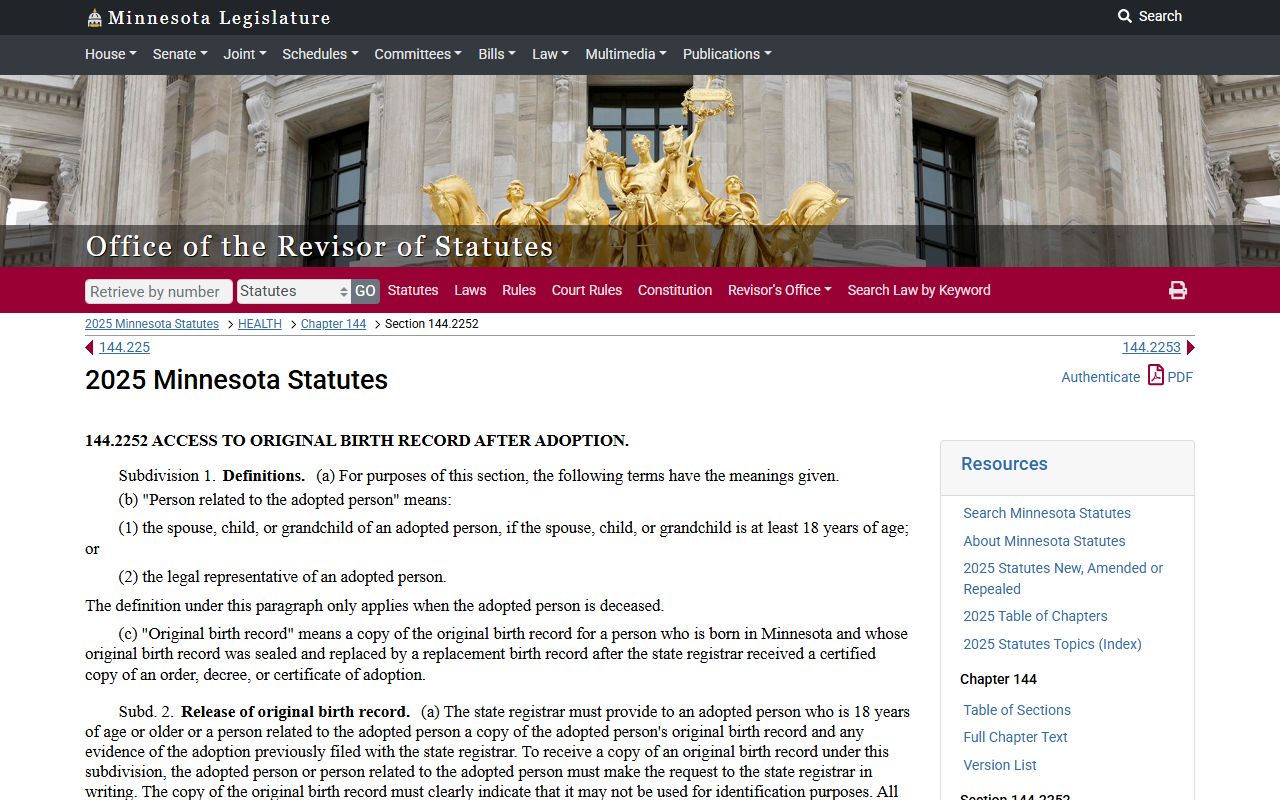
Statute 144.2252 governs adopted persons' access to original birth records and outlines the expanded rights that took effect on July 1, 2024.
Minnesota government data practices fall under Minn. Stat. Section 13.02, which defines public, private, and confidential data held by government agencies. Death records are fully public under Minnesota law, meaning anyone can request a noncertified copy. Birth records are generally public with exceptions for records of children born to unmarried parents. Adoption-related records remain sealed for 100 years unless a court order opens them.
Key Minnesota Genealogy Organizations
The Minnesota Genealogical Society is a major resource for genealogy research in the state. Located at 1385 Mendota Heights Road, Suite 100, Mendota Heights, MN 55120. Phone: 651-330-9312. They hold the William J. Hoffman Library and Research Center, operate as a FamilySearch Affiliate Library, and maintain a cemetery project covering locations and records across Minnesota. They also run ethnic special interest groups and offer educational resources for researchers at all levels.
The Minnesota Genealogical Society maintains a research library and provides access to databases and collections that support all levels of genealogy research.
MHS also operates six Regional Research Centers across the state, each housed at a university campus. The Central Minnesota Historical Center in St. Cloud at 320-308-4753 serves a dozen counties in the central part of the state. The Northeast Minnesota Historical Center at the University of Minnesota-Duluth at 218-726-8526 serves Carlton, Cook, Lake, and St. Louis counties. The Northwest Minnesota Historical Center in Moorhead at 218-236-2345 covers the northwestern counties. Southern, Southwest, and West Central centers round out statewide coverage. These regional centers hold local county records not always available at the main St. Paul library.
Fees for Minnesota Genealogy Records
The Minnesota Department of Health sets the fee schedule for vital records statewide. A certified birth certificate costs $26. A certified death certificate costs $13. Noncertified versions of either cost $13 each. Verification of birth or death facts is $9. Adoption original birth records cost $40 per request. County offices generally follow these same fee amounts, though some may vary slightly. Contact the specific county for exact current pricing before you send a payment.
MHS research services have their own fee schedule that varies by service type. Details are at mnhs.org/library. For will books, court documents, and naturalization files, MHS charges for copies and research time. In-library visits to the Gale Family Library are generally free for self-service research. MOMS marriage record searching is free. State census and veterans graves records are free to search and view through MHS People Records Search. Federal land patent records through BLM are also free to view online.
Note: All fees at MDH are non-refundable even if the record is not found. Confirm current fee amounts before submitting payment, as rates can change.
Browse Minnesota Genealogy Records by County
Each of Minnesota's 87 counties holds its own vital records, court files, and local genealogy resources. Pick a county below to find resources and guidance specific to that area.
Minnesota Genealogy Records by City
Residents of major Minnesota cities can access genealogy records through their county offices and statewide databases. Select a city to find local resources and guidance.